
| James Cronan |
When you look at it today, the phrase ‘for all the tea in China’ seems a little odd. The three most popular black teas all originate from South East Asia, with Darjeeling, Assam and Ceylon being the most well-known. But back in the middle of the 19th century it was a very different story. Those teas had yet to become popular, and it was instead the Chinese teas which were heavily imported, including Congou, Keemun and Oolong.
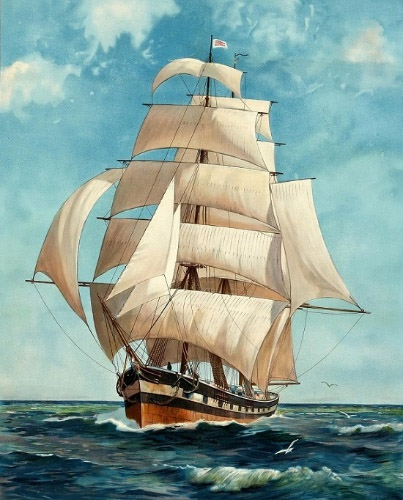
Clipper ship in full sail. Inset from a poster advertising the Clipper Tyre Company Ltd, registered at Stationers’ Hall, 1906. Catalogue ref: COPY 1/239 (123)
In 1854 the first international race was recorded which involved just two competitors – the clipper ships Chrysolite and Celestial. On 14 July 1854, Chrysolite sailed from Foochow and Celestial from Whampoa, with the Chrysolite arriving at Deal after 108 days, one day ahead of Celestial. To spice up the competition, an additional payment of 10 shillings per ton was allotted to the owner of the cargo of the first ship arriving in dock.
By 1866 the competition had grown considerably, and the fastest and newest clipper ships assembled in Foochow in May to begin loading tea chests for the journey. From the lists of shipping in port, printed in the Foochow Advertiser, we can put together the details of the competitors. The following are the names of the nine ships, their owners and commanders, their tonnage, the ports where they were built, and the respective departure dates:
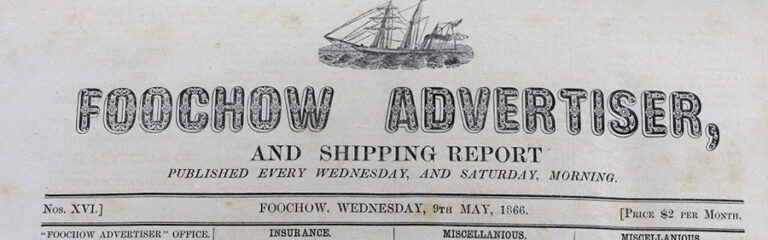
Foochow Advertiser, 9 May 1866. Catalogue ref: FO 228/408
| Name | Tonnage | Captains | Where built | Year built | Official no. | Port of registry | Owners | Left Foochow |
| Ada | 686 | Jones | Aberdeen | 1865 | 54577 | London | Wade & Co | June 6 |
| Ariel | 853 | Keay | Greenock | 1865 | 52743 | London | Shaw & Lowther | May 30 |
| Black Prince | 750 | Inglis | Aberdeen | 1863 | 48501 | London | Findlay & Co | June 3 |
| Chinaman | 668 | Downie | Greenock | 1865 | 52676 | London | Park Brothers | June 5 |
| Fiery Cross | 689 | Robinson | Liverpool | 1861 | 29165 | Liverpool | J Campbell | May 29 |
| Flying Spur | 731 | Ryrie | Aberdeen | 1860 | 29004 | London | Robertson & Co | June 5 |
| Serica | 708 | Innes | Greenock | 1863 | 45261 | Greenock | Findlay & Co | May 30 |
| Taeping | 767 | McKinnon | Greenock | 1864 | 47842 | Greenock | Roger & Co | May 30 |
| Taitsing | 815 | Nutsford | Glasgow | 1864 | 49555 | Greenock | Findlay & Co | May 31 |
The loading took place at the Pagoda Anchorage, at the heart of the tea district. Every spare inch of space would be used up to carry as much as possible of the precious cargo. Taeping was loaded with 1,108,709 lbs of tea; Ariel, 1,230,900 lbs; Serica, 954.236 lbs; Fiery Cross, 854,230 lbs and Taitaing, 1,093,130 lbs.
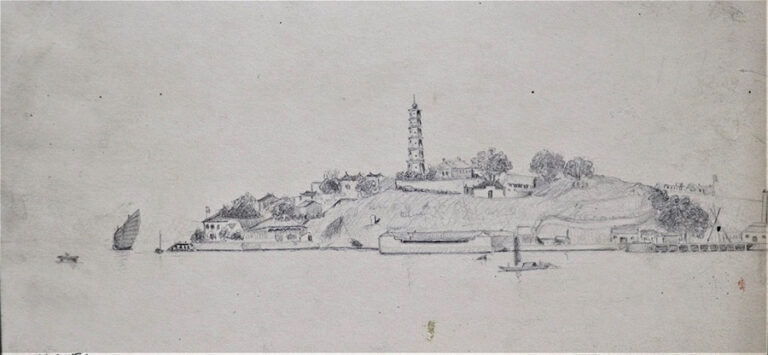
From the anchorage the ships had to be towed down the River Min and across the tidal breakwater and to the open sea.
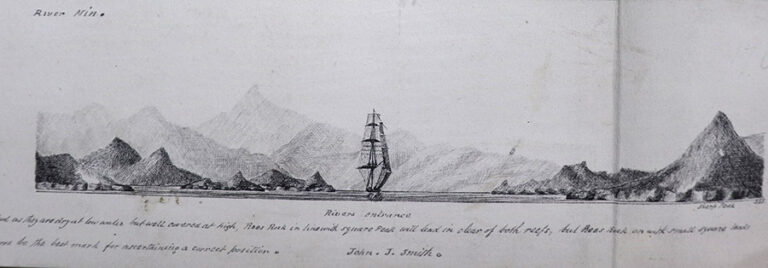
The competitors
Fiery Cross was built 1861, which made it one of the oldest clippers in the competition, but it was also the most successful, having won the race four times, in 1861, 1862, 1863 and 1865. The ship was constructed by Chaloner of Liverpool. It was the lightest ship at 689 tons, although this was not always an advantage. Many of the clipper ships carried ballast such as lead or iron weights to make the boat sit lower in the water and to increase stability and weight distribution.
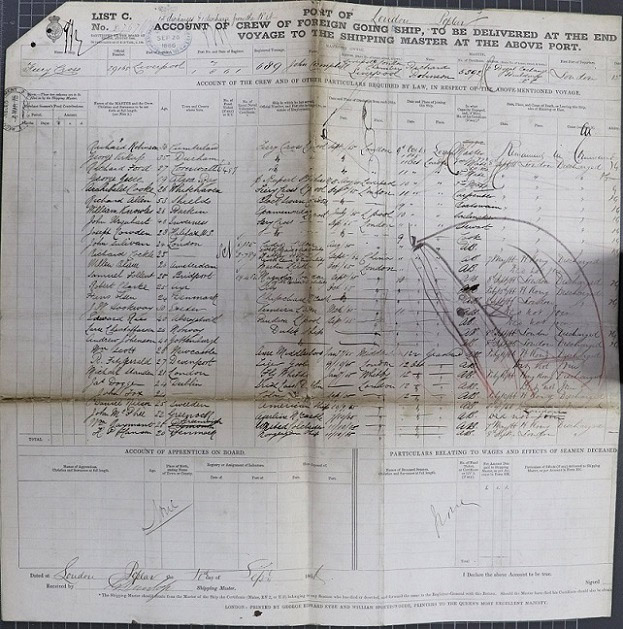
The Master of the Fiery Cross was Richard Robinson, aged 30, from Seaton in Cumberland. An experienced sailor, he first went to sea as an apprentice in 1844 and qualified as Master in 1854. Fiery Cross sailed from Foochow with a full complement of 32 crewmen. 13 of the outgoing crew on the voyage from London were discharged at Hong Kong, and as a result Robinson took on 12 men at Hong Kong, including nine able seamen, and one at Foochow.
Serica was built in 1863, and won the competition on its first attempt in 1864. The ship was constructed by Robert Steele of Greenock, and was heavier than Fiery Cross, weighing in at 707 tons. George Innes, the ship’s master, was the oldest of the captains, and was born in Aberdeen in 1824. He first went to sea as apprentice in 1839 and was issued with his Master’s certificate in 1852.
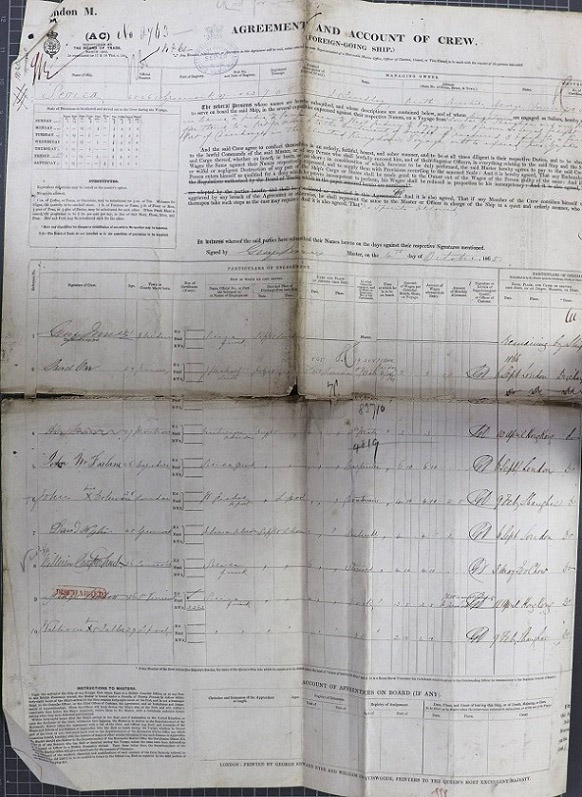
Serica sailed from Foochow with a full complement of 32 crewmen. 5 able seamen had earlier been discharged and replaced at Shanghai in February 1866, and 16 crew were discharged and replaced at Hong Kong in April, including the 3rd Mate and the Cook. A crew of 32 allowed for two watches of 14 sailors to be on duty at any time, with a reserve of four crew who could be used at any time.
Taeping was an even more recent clipper, built in 1864 by Robert Steele of Greenock, and was slightly heavier, at 767 tons. The Master, Donald McKinnon, was born on the island of Tiree, in Argyllshire, in 1828. He first went to sea as an apprentice in 1843, and obtained his Master’s certificate in 1851. McKinnon had also qualified as a Lieutenant in the Royal Naval Reserve in 1854, making him the only master of the main competitors who could use the term Commander. His RNR service record, which is held in the series ADM 240, describes him as 5ft 5 in tall, with brown hair, blue eyes, and a scar on his nose.
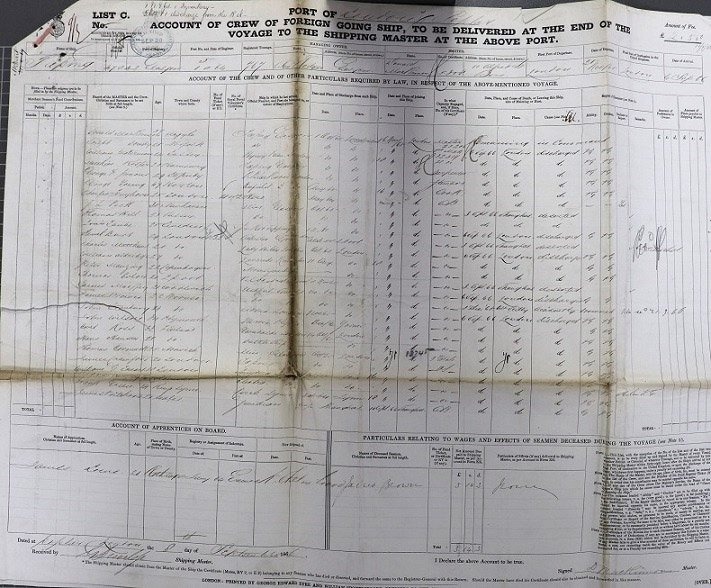
Taeping had commenced its outward voyage from London on 20 November 1865 with only 26 crewmen. It sailed from Foochow with 27 crew, as four able seamen deserted at Shanghai on 3 April 1866 and they were replaced at Shanghai on 10 April with a further seaman taken on at Amoy on 21 April. This made it short of its complement by five crew, but that would not hamper its performance; it merely meant that the remaining seamen had to work even harder.
Taitsing, which was also built 1864, was constructed by Connell of Glasgow, and was heavier still, at 815 tons. It was taking part in its first tea race from Foochow. Taitsing’s Master, Daniel Nutsford, was born in Whitehaven, Cumberland on 6 June 1835, making him the youngest of the Captains in the race. He first went to sea as an apprentice in 1852, and was only issued with a Master’s certificate in October 1865, one month before the outward voyage from London. But he still brought with him a lot of experience at sea, and had qualified as 2nd Mate in 1858. He was very well chosen for this particular voyage, as he had made it four times before, twice on the Fiery Cross and twice on the Serica. Nutsford had served as 2nd Mate on Fiery Cross between December 1861 and September 1863, and as 1st Mate on Serica between November 1863 and September 1865.
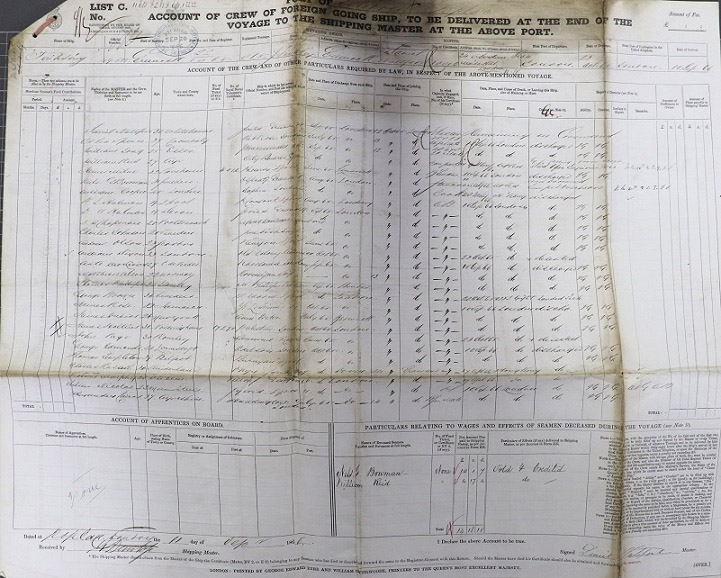
Taitsing’s outward voyage commenced from London on 23 October 1865. Able seaman George Brown was landed sick on the Isle of Wight, only five days into the voyage, on 28 October, and the Carpenter, William Reid, died after falling from the main mast when making repairs on 9 November 1865. Additionally, Steward, Niels G Bowman, from Sweden, jumped overboard when at sea on 10 March 1866 and drowned. The Carpenter was replaced at Hong Kong on 17 February 1866, and the Steward was replaced on 20 April along with the Cook and four able seamen. On 11 May 1866, shortly before Taitsing was due to leave Foochow, the Master was also obliged to take back as a passenger Alfred Brunton, the Master of the Young Lochinvar, a ship which had earlier run aground near the entrance to the Min River, off Foochow.
Ariel was the newest ship of the five built 1865 of Iron-Wood composite, and was the heaviest, at 852 tons. Like Serica and Taeping, Ariel was constructed by Robert Steele of Greenock. Although it was on its first run, Ariel had a very experienced Master. John Keay was born in Anstruther, Fife, in 1828, and first went to sea as apprentice in 1843. He obtained his Master’s certificate in 1853.
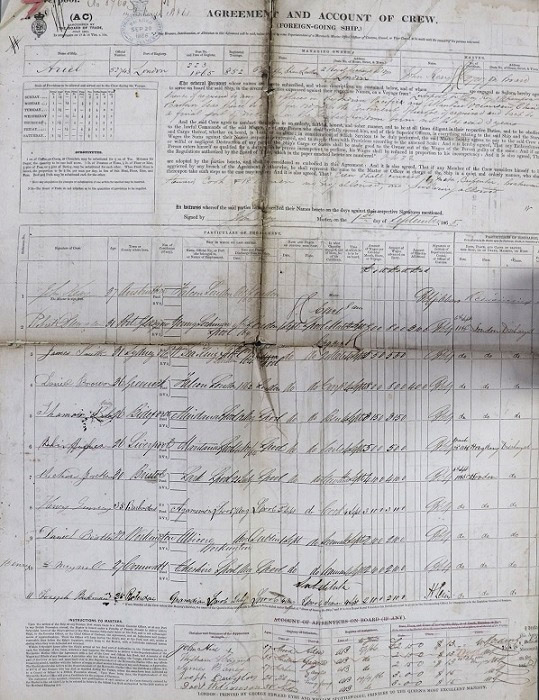
Ariel’s outward voyage commenced from Liverpool on 4 September 1865. The clipper left Foochow with a full complement of 32 crew, including Ordinary Seaman Charles Gifford, formerly of the Young Lochinvar, who was working his passage home, and so received no pay.
The voyage home
Unfortunately, while crew lists and agreements and log books survive for all of the five main competitors, they tell us very little about the voyage itself, recording instead, as required by law, the full details of the crew, their contracts and rates of pay, and only basic details of the voyage such as departure and arrival. However, there was considerable interest in the race, and details of progress was telegraphed to Lloyd’s at various staging points and released to the press. Readers were kept up to date in articles and in the shipping sections of newspapers such as the Pall Mall Gazette and the Times, from which this narrative is drawn.
Fiery Cross obtained a start of one day over the others, departing on 29 May. Serica, Ariel and Taeping crossed the bar of Foochow in company together on 30 May. Taitsing started the following day.
Fiery Cross followed the prevailing winds, which took them to the Paracel islands, in the South China Sea, on 3 June. Serica, Ariel and Taeping met with similar weather. Fiery Cross saw nothing of them until 7 June when she passed Ariel on the opposite tack. The next sighting point was at Anjer, in the Strait between Java and Sumatra. Fiery Cross passed the lighthouse at Anjer on 18 June, Ariel and Taeping on 20 June, and Serica and Taitsing on 22 June. So by this stage Fiery Cross had a two-day lead over Ariel and Taeping. Taitsing had caught up on Serica and both ships were a further two days behind. Fiery Cross passed Mauritius on 30 June and Ariel followed suit on 2 July. On 15 July Fiery Cross rounded the Cape of Good Hope, still in the lead, with Ariel a day behind and Serica a full week behind.
On 9 August Taeping had caught up with Fiery Cross, and the two sailed together until 17 August, when Taeping took advantage of a westerly breeze to move out of sight of its rival, which was becalmed and barely moving for the next 24 hours. On the morning of 6 September Fiery Cross passed the Isle of Wight, unaware of the location of its rivals and its position in the race. As it turned out the lull had made a considerable difference.
On 5 September Ariel and Taeping, which had last been in sight over 70 days ago, found themselves off the Lizard running neck and neck up the channel, with all their sails set to take full advantage of a strong westerly wind. They raced together for the whole day, darting up the channel until they reached Dungeness, when they signalled the pilot station for pilots to board and take towards the Thames, as required by law.
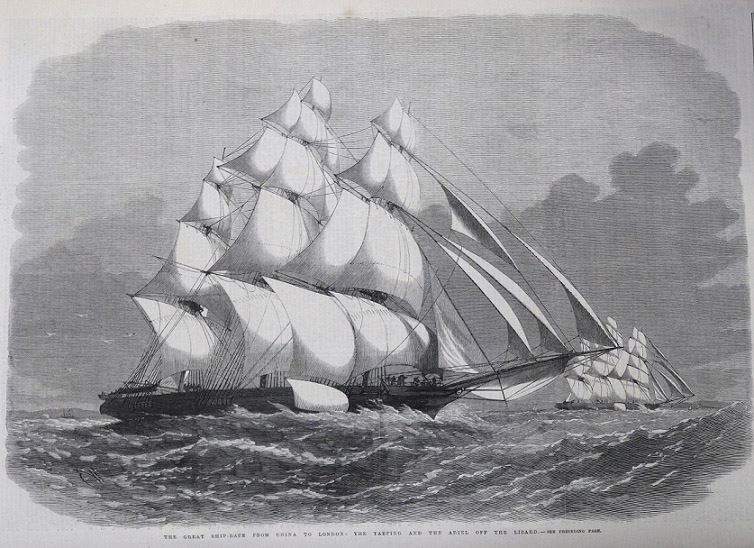
On the morning of 6 September both ships reached the Downs, where they needed to find steam tugs to tow them up the river. Both ships found tugs at about the same time, but Taeping found the more powerful one, and reached Gravesend some time before Ariel. Serica, meanwhile, followed in their wake, passing Deal at noon on the 6th, and reaching the Thames on the same tide as the leaders, a little over an hour later. Thanks to a faster and more powerful tug, Taeping docked in London Dock at 21:45, claiming first place, while Ariel docked at East India Dock only half an hour later at 22:15 and Serica docked at West India Dock at 23:30, within two hours of the victors.
Fiery Cross reached the Downs on 7 September but was compelled to drop anchor due to heavy winds. The clipper, which had for so long been in the lead, finally managed to get into London Dock by 08:00 on Saturday 8 September, with Taitsing arriving a few hours later.
Taeping was declared the winner of the premium, but due to the nature of the victory and the closeness in times, the prize was shared between Taeping and Ariel. The voyage for the first three ships took only 99 days, a whole week shorter than the time taken by Fiery Cross and Serica the previous year.
As things turned out, 1866 would be the last year in which a prize was offered for bringing back the first teas of the season. Despite the excitement and the acclaim, the premium proved to be unsustainable. Huge harvests in 1865 and 1866 had caused a glut in the market which meant that the cargoes of the first ships home were met with indifference and low prices from the buyers in London. The race continued for a few years, up to the 1870s, and even included the Cutty Sark as a competitor. By this time the era of the clipper ship had largely finished. Steamships were faster and were able to carry more cargo and were not dependent upon the prevailing winds.
In 1869 the Suez Canal was opened, providing a shorter route to and from China. This route was virtually impossible for sailing ships, which would have to be towed through the canal, and they gradually became obsolete as trading vessels.
You are not authorised to post comments.