
Labor Day: What it Means
Labor Day, the first Monday in September, is a creation of the labor movement and is dedicated to the social and economic achievements of American workers. It constitutes a yearly national tribute to the contributions workers have made to the strength, prosperity, and well-being of our country.
Labor Day Legislation
The first governmental recognition came through municipal ordinances passed in 1885 and 1886. From these, a movement developed to secure state legislation. The first state bill was introduced into the New York legislature, but the first to become law was passed by Oregon on February 21, 1887. During 1887, four more states – Colorado, Massachusetts, New Jersey, and New York – created the Labor Day holiday by legislative enactment. By the end of the decade Connecticut, Nebraska, and Pennsylvania had followed suit. By 1894, 23 more states had adopted the holiday, and on June 28, 1894, Congress passed an act making the first Monday in September of each year a legal holiday in the District of Columbia and the territories.
Founder of Labor Day
More than a century after the first Labor Day observance, there is still some doubt as to who first proposed the holiday for workers.
Some records show that Peter J. McGuire, general secretary of the Brotherhood of Carpenters and Joiners and a co-founder of the American Federation of Labor, was first in suggesting a day to honor those "who from rude nature have delved and carved all the grandeur we behold."
But Peter McGuire's place in Labor Day history has not gone unchallenged. Many believe that Matthew Maguire, a machinist, not Peter McGuire, founded the holiday. Recent research seems to support the contention that Matthew Maguire, later the secretary of Local 344 of the International Association of Machinists in Paterson, N.J., proposed the holiday in 1882 while serving as secretary of the Central Labor Union in New York. What is clear is that the Central Labor Union adopted a Labor Day proposal and appointed a committee to plan a demonstration and picnic.
The First Labor Day
The first Labor Day holiday was celebrated on Tuesday, September 5, 1882, in New York City, in accordance with the plans of the Central Labor Union. The Central Labor Union held its second Labor Day holiday just a year later, on September 5, 1883.
By 1894, 23 more states had adopted the holiday, and on June 28, 1894, President Grover Cleveland signed a law making the first Monday in September of each year a national holiday.
A Nationwide Holiday
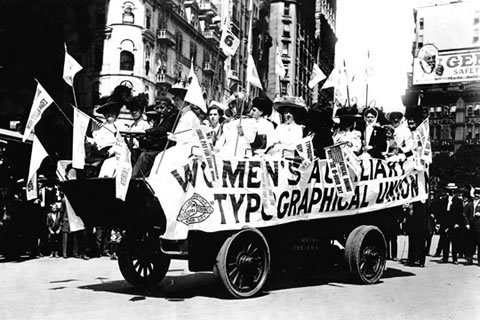
The form that the observance and celebration of Labor Day should take was outlined in the first proposal of the holiday — a street parade to exhibit to the public "the strength and esprit de corps of the trade and labor organizations" of the community, followed by a festival for the recreation and amusement of the workers and their families. This became the pattern for the celebrations of Labor Day. Speeches by prominent men and women were introduced later, as more emphasis was placed upon the economic and civic significance of the holiday. Still later, by a resolution of the American Federation of Labor convention of 1909, the Sunday preceding Labor Day was adopted as Labor Sunday and dedicated to the spiritual and educational aspects of the labor movement.
The character of the Labor Day celebration has changed in recent years, especially in large industrial centers where mass displays and huge parades have proved a problem. This change, however, is more a shift in emphasis and medium of expression. Labor Day addresses by leading union officials, industrialists, educators, clerics, and government officials are given wide coverage in newspapers, radio, and television.
The vital force of labor added materially to the highest standard of living and the greatest production the world has ever known and has brought us closer to the realization of our traditional ideals of economic and political democracy. It is appropriate, therefore, that the nation pays tribute on Labor Day to the creator of so much of the nation's strength, freedom, and leadership – the American worker.
What is the Haymarket affair?

On May 4, 1886—at a time when most American laborers worked 18 or even 20 hours a day—tens of thousands of workers protested in cities all across the US to demand an eight-hour workday. Police in Chicago attacked both those peaceful protests and a workers planning meeting two days later, randomly beating and shooting at the planning group and killing six. When outraged Chicagoans attended an initially peaceful protest the next evening in Haymarket Square, police advanced on the crowd again. Someone who was never identified exploded a bomb that killed a police officer, leading cops to open fire on protesters and provoke violence that led to the deaths of about a dozen workers and police.
The Pullman strike

Ironically, Chicago was also the setting for the bloody Pullman strike of 1894, which catalyzed the establishment of an official Labor Day holiday in the U.S. on the first Monday of September.
The strike happened in May in the company town of Pullman, Chicago, a factory location established by luxury railroad car manufacturer the Pullman Company. The inequality of the town was more than apparent. Company owner George Pullman lived in a mansion while most laborers stayed in barracks-style dormitories. When a nationwide depression struck in 1893, Pullman decided to cut costs the way a lot of executives at the time did—by lowering wages by almost 30% while he kept rent on the dormitories he leased to his workers at pre-depression levels.
Railroad boycott
These conditions ultimately led workers to strike on May 11, 1894. The walkout gained the support of the nationwide American Railroad Union (ARU), which declared that ARU members would no longer work on trains that included Pullman cars. That national boycott would end up bringing the railroads west of Chicago to a standstill and led to 125,000 workers across 29 railroad companies to quit their jobs rather than break the boycott.
When the Chicago railroad companies hired strikebreakers as replacements, strikers also took various actions to stop the trains. The General Managers Association, which represented local railroad companies, countered by inducing U.S. Attorney General Richard Olney, a former railroad attorney, to intervene. Indianapolis federal courts granted Olney an injunction against the strike, a moved that allowed President Grover Cleveland to send in federal troops to break it up.
A few days later, Cleveland realized that he had to act quickly to appease the country’s increasingly agitated labor movement. But he didn’t want to commemorate the Haymarket incident with a May holiday that would invoke radical worker sentiment. So Cleveland harkened back to the first established September 1882 holiday and signed into law that Labor Day in the US would be celebrated on the first Monday in September.
Labor Day vs. May Day
Communist and socialist factions worldwide eventually chose May 1 as the date to mark the Haymarket affair. A 1904 conference issued a plea that trade unions stage rallies on the first day of May — demanding to make the eight-hour workday standard. They organized the action in the name of “universal peace.” The first of May is a national, public holiday in many countries across the world, generally known as “Labour Day,” “International Workers’ Day,” or some similar name – although some countries celebrate a Labour Day on other dates significant to them, such as Canada, which celebrate Labor Day, like the U.S., on the first Monday of September.
Here’s the U.S. Department of Labor’s official tribute to U.S. workers on Labor Day:
“The vital force of labor added materially to the highest standard of living and the greatest production the world has ever known, and has brought us closer to the realization of our traditional ideals of economic and political democracy. It is appropriate, therefore, that the nation pays tribute on Labor Day to the creator of so much of the nation’s strength, freedom, and leadership — the American worker.”
You are not authorised to post comments.