
Christmas During the Battle of the Bulge
by Jenny Ashcraft |
On December 16, 1944, German forces surprised American soldiers in the densely forested Ardennes region of Belgium, Luxembourg, and France, with a massive offensive also known as the Battle of the Bulge, or the Ardennes Counteroffensive. Germany pushed through an Allied line, creating a bulge in the Allied defensive lines. The deadly battle, which lasted until January 25, 1945, was the largest on the European western front during WWII and resulted in an estimated 1 in 10 American combat casualties during the entire war. It also meant that thousands of soldiers spent Christmas 1944 in temperatures that hovered around zero, in knee-deep snow, and with limited rations for Christmas dinner. On the home front, their families spent a nervous holiday season, waiting for word of their loved ones.
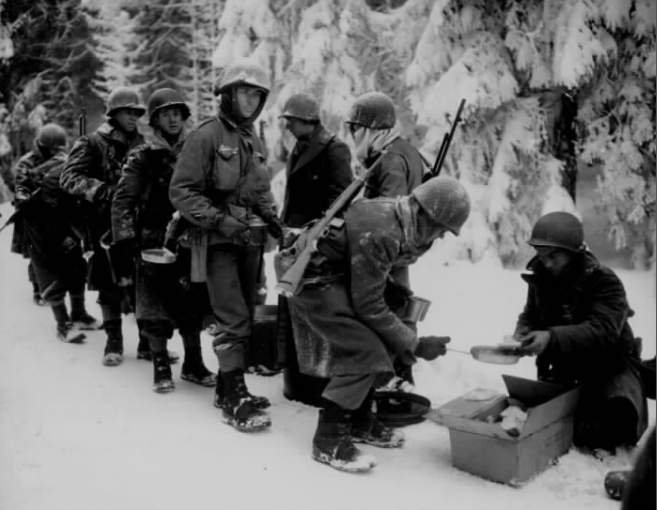
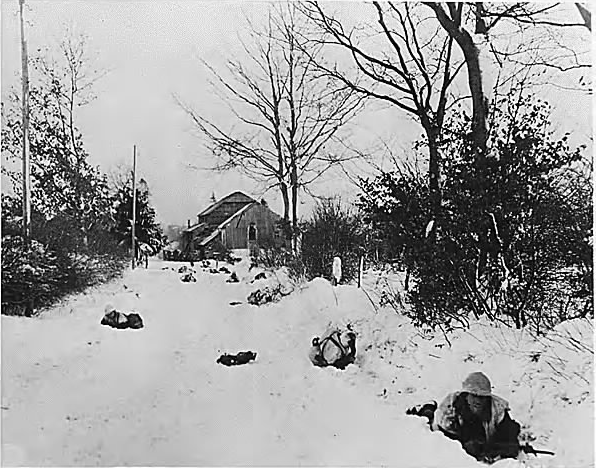
Cpl. Frank D. Vari spent Christmas Eve huddled in a foxhole as shells exploded around him all night long. “We could hear their guns going off and the shells landing at the same time. They were close. They almost surrounded the whole place. I remember Christmas Day. I got up, and we had a real bad night, with artillery and everything. The first thing I saw was the steeple of a church down in the valley. It was a beautiful day, the sun was just coming up over a little village at the bottom.” The clear skies allowed US planes to reinforce soldiers along the front. The break in the weather saved Vari’s unit.
Sgt. Metro Sikorsky woke up Christmas Day 1944 in a bombed-out building. He was 25-years-old and serving in Company B, 17th Tank Battalion of the 7th Armored Division. It was his first time away from home in Pennsylvania. All around were the bodies of the frozen and his job included picking up the dead. He said it was so cold that when a soldier died, in a short time the body froze where it lay. There were no presents and no Christmas dinner, but Sikorsky felt lucky to be alive. It was so cold that soldiers cut blankets into strips and wound them around their frozen feet.
Tech Sgt. Maurice Glenn Hughs remembered the terrible winter conditions during the battle. “Hundreds of people lost their feet because they were frozen,” he said. Hughs was hospitalized after the battle and doctors in Paris told him that his feet would need to be amputated. “My legs were painted up to my knees to be amputated. And then the doctors checked and said they wouldn’t have to be,” said Hughs.
Mattie Dickenson of Georgetown, Louisiana, remembered Christmas 1944 as a difficult one. She anxiously waited for news from her husband Benjamin F. Dickenson. Benjamin was drafted when he was 38-years-old and found himself fighting in the Battle of the Bulge. “I do remember that was the saddest Christmas I ever spent. For 21 days I didn’t know if he was dead or alive,” said Mattie. Though Benjamin was wounded, he made it home alive. Mattie kept a piece of the parachute that dropped supplies to her husband at Bastogne.
Soldiers from the Third United States Army carried a printed copy of Gen. George Patton’s Christmas Prayer of 1944. Patton had a copy distributed to each soldier before the battle. It petitioned the heavens for good weather and concluded with a Christmas greeting from the General. It read, “To each officer and soldier in the Third United States Army, I wish a Merry Christmas. I have full confidence in your courage, devotion to duty, and skill in battle. We march in our might to complete the victory. May God’s blessings rest upon each of you on this Christmas Day.”
The Battle of the Bulge was Hitler’s last major offensive along the Western Front. Within a month Allied forces pushed the Germans back and closed the bulge. The battle was called “the greatest American battle of the war” by Winston Churchill and it crushed Germany’s hopes for ultimate success in the war. To learn more about the Battle of the Bulge and soldiers who fought in it, search Fold3 today!
You are not authorised to post comments.